Ninja Air Fryer vs Tefal: Which One Is Worth Your Money?

Air fryers have become one of the most popular kitchen appliances in recent years, promising crispier meals with significantly less oil and faster cooking times. Two brands consistently dominate the conversation: Ninja Air fryer vs Tefal. Both have built strong reputations in the kitchen appliance space, but they approach air frying in noticeably different ways. Whether the priority is versatility, convenience, cooking performance, or budget, understanding how these two brands stack up against each other is essential before making a purchase.
This article takes an in-depth look at the Ninja Air Fryer vs Tefal debate, covering everything from design and features to cooking results, ease of cleaning, and overall value for money.
“An air fryer isn’t just another appliance. It’s something you’ll use regularly. Build quality, materials, and usability play a huge role in your experience.”
— Healthy Kitchen Reviews
Key Takeaways
- Ninja excels in multifunctionality, dual-basket cooking, and powerful performance, making it ideal for families and meal preppers.
- Tefal stands out for its unique ActiFry stirring paddle technology, beginner-friendly presets, and sleeker, more compact designs.
- Ninja tends to offer better long-term versatility, while Tefal delivers consistent, hands-free cooking results with minimal intervention.
- In terms of price, both brands offer models across a wide range, but Ninja’s premium models can cost significantly more than comparable Tefal options.
- The best choice depends on cooking habits, kitchen space, and whether hands-free convenience or multi-function power is the top priority.
Ninja Air Fryer vs Tefal
No products found.
No products found.
Design and Build Quality
First impressions matter, and these two brands take very different visual and structural approaches.
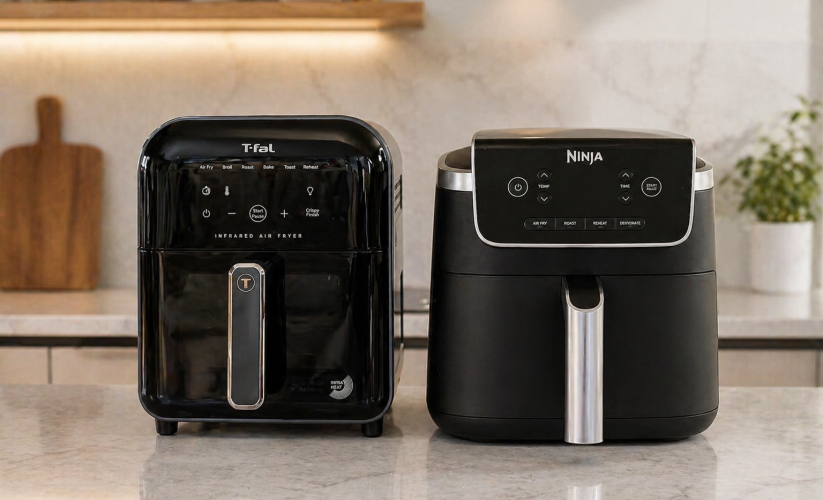
Tefal air fryers are often praised for their sleek, modern aesthetic. Their designs tend to be more compact and space-saving, making them a smart fit for kitchens with limited counter space. Many Tefal models feature intuitive touchscreen controls and a minimalist look that blends well with contemporary kitchen decor. The tradeoff is that some Tefal models can actually be bulkier than they appear due to the internal mechanics required for their signature rotating paddle. For those working with tight counter space, this is worth factoring in before buying.
Ninja, on the other hand, leans into a more robust, utilitarian aesthetic. Their air fryers often incorporate stainless steel accents and prominent control panels. While some may find them less polished-looking than Tefal models, Ninja’s design philosophy prioritizes functionality and ease of use. The larger footprint often translates to bigger cooking capacities, making Ninja models particularly well-suited to families or anyone who regularly cooks in large batches.
In terms of build quality, both brands deliver reliable appliances. Ninja air fryers are widely perceived as slightly more robust and durable, built to withstand heavy, frequent use. Tefal models, while well-constructed, sometimes use lighter materials to achieve their more streamlined appearance. For everyday home cooking, either brand holds up well over time.
Features and Functionality
This is where the two brands diverge most significantly, and where the right choice depends heavily on individual cooking needs.
Tefal is the pioneer of the low-fat fryer concept, having launched the ActiFry well over a decade ago. Its most distinctive feature remains the rotating stirring paddle, which continuously moves ingredients around during cooking. This means foods like French fries, stir-fried vegetables, and rice dishes cook evenly without the need to manually shake the basket every few minutes. For those who prefer a more hands-off cooking experience, this is a genuinely useful innovation. Many Tefal models also include pre-programmed cooking modes for popular dishes, simplifying the process for beginners or those who don’t want to think too hard about temperature and timing settings. Some higher-end Tefal models even offer smart connectivity through a dedicated app, providing recipe inspiration and remote control functionality.
Ninja takes a broader approach to functionality. Many Ninja models go well beyond simple air frying, offering roasting, baking, dehydrating, and in some configurations, even pressure cooking. This multi-functionality allows one appliance to replace several others, which is a real advantage for those looking to save kitchen space and streamline meal preparation. One of Ninja’s most celebrated features is the dual-basket design found in models like the Foodi Dual Zone, which allows two completely different foods to be cooked simultaneously at independent temperatures and timer settings. This is a game-changer for meal prepping or preparing multiple components of a dish at once. Certain premium Ninja models also include a temperature probe for monitoring internal food temperature, reducing the guesswork around cooking meat to the correct doneness.
One notable limitation of Ninja air fryers is the absence of a viewing window on most models. This means the basket must be opened and cooking paused to check on food progress, which can interrupt the cooking process. Tefal models, in contrast, often include a transparent window, allowing a visual check without interrupting cooking.
Cooking Performance
At the end of the day, the most important question is: how does the food actually turn out?
Tefal air fryers generally excel at producing evenly cooked results, particularly for foods that benefit from constant movement. The automatic stirring paddle ensures consistent crispiness throughout the batch, which is something that basket-style fryers can struggle with when overloaded. For classic dishes like chips, chicken wings, or stir-fried vegetables, the ActiFry system delivers reliable, repeatable results with very little effort required.
Ninja air fryers shine when it comes to speed and power. Their rapid air circulation systems heat up quickly and cook food fast, which is a significant advantage during busy weeknights. The dual-basket models in particular allow full meals to be prepared simultaneously, cutting overall cooking time considerably. The wide temperature range across Ninja models also means more versatility in the types of dishes that can be prepared, from delicate dehydrated fruits to high-heat roasted meats.
It is worth noting that independent testing by outlets like RTINGS.com has found that while Ninja models outperform Tefal in several functional areas, the Tefal Easy Fry range can actually produce better-quality fried food in direct head-to-head tests. Cooking quality, in other words, is not always a clean sweep in either direction, and much depends on the specific models being compared and the type of food being cooked.
Ease of Cleaning and Maintenance
No one wants to spend more time cleaning than cooking, so this is an important practical consideration.
Both Ninja and Tefal air fryers generally feature non-stick coated baskets that are dishwasher-safe, making cleanup relatively straightforward. The non-stick coating on Ninja baskets is widely praised for reducing food sticking and keeping maintenance simple.
Tefal’s stirring paddle, while a cooking advantage, does add one more component to clean after each use. For some, this is a minor inconvenience; for others, the extra step can be a deterrent, especially for quick weeknight meals. The paddle is removable and dishwasher-safe on most models, which helps.
Ninja’s basket designs, particularly in the dual-zone models, are simple and intuitive to remove and clean. The absence of a paddle means there are fewer components to deal with after cooking.
Price and Value
Both brands offer models across a wide price spectrum, so budget alone does not determine which brand to choose.
Entry-level Ninja models start at around £70 to £80, while premium options like the Foodi Dual Zone can retail for over £200. Tefal models are generally available at comparable price points for entry-level options, but their dual-zone models tend to come in at a lower price than Ninja’s equivalent. A Tefal Easy Fry Dual Zone, for example, has been available at around £99 at retail, compared to a Ninja Foodi Max Dual Zone that typically retails closer to £270. For budget-conscious buyers who still want dual-basket functionality, Tefal offers a compelling value proposition.
Where Ninja justifies its higher price points is in the breadth of cooking functions, build quality perception, and the overall versatility of its premium range. For households that will genuinely use those extra functions, the investment can pay off over time.
One additional consideration: Ninja provides a 12-month warranty on most models, which is shorter than the warranty period typically offered by Tefal. This is a minor but relevant point for anyone thinking about long-term reliability and after-sales support.
Which One Is Right for You?
Choosing between a Ninja and a Tefal air fryer comes down to what matters most in the kitchen.
For those who prioritize hands-free, consistent cooking with minimal monitoring, Tefal is a strong contender. The automatic stirring paddle, compact design options, and beginner-friendly presets make it an excellent choice for everyday family cooking, particularly for staples like fries, vegetables, and simple protein dishes.
For those who want maximum versatility and the ability to cook multiple dishes simultaneously, Ninja is the more compelling option. The dual-basket technology, wide cooking function range, and powerful performance make it a workhorse appliance that can handle complex meal prep with ease.
Budget buyers will find solid options from both brands, but Tefal tends to offer more competitive pricing for dual-zone functionality. Those willing to invest more for long-term multifunctionality will likely lean toward Ninja.
Conclusion
The Ninja Air Fryer vs Tefal debate does not have a single definitive winner because both brands serve different types of cooks. Tefal wins on hands-free convenience, smart design, and value in the dual-zone category. Ninja wins on versatility, multi-function power, and overall cooking capacity. The best approach is to identify which features align most closely with actual cooking habits and kitchen needs, then choose accordingly. Either way, both brands offer a significant upgrade over traditional deep frying in terms of health, speed, and convenience.
Frequently Asked Questions
1. Is a Ninja air fryer better than a Tefal for a family of four?
For families, Ninja is often the better choice due to its larger capacity models and dual-basket designs, which allow two different dishes to be cooked simultaneously. This makes meal prep faster and more efficient for households with varying preferences.
2. Does Tefal’s stirring paddle really make a difference?
Yes, the ActiFry stirring paddle makes a noticeable difference for foods that require even movement during cooking, such as chips, stir-fries, and tossed vegetables. It eliminates the need to manually shake the basket, resulting in more consistent crispiness with less hands-on time.
3. Which brand is easier to clean?
Both brands use dishwasher-safe, non-stick baskets, so cleanup is manageable for either option. Ninja’s simpler basket design has fewer components to clean, while Tefal requires the additional step of removing and washing the stirring paddle.
4. Are Tefal air fryers cheaper than Ninja?
Generally, Tefal air fryers tend to be priced more competitively at the mid-range and dual-zone level. Entry-level prices are similar across both brands, but Ninja’s premium models carry a higher price tag that reflects their expanded feature set.
5. Can a Ninja air fryer replace multiple kitchen appliances?
Many Ninja models are designed with this goal in mind. Depending on the model, a single Ninja air fryer can function as an air fryer, roaster, baker, dehydrator, and in some cases a pressure cooker, reducing the need for multiple separate appliances and freeing up kitchen space.
Last update on 2026-10-11 / Affiliate links / Images from Amazon Product Advertising API
*We may earn a commission for purchases made using our links. Please see our disclosure to learn more.