Can You Put Foil in a Ninja Air Fryer?

Yes, you can put aluminum foil in a Ninja air fryer when the foil is secured under food, kept away from the heating element, and placed so it does not block airflow.
I use foil in an air fryer as a tool, not as a default liner. That distinction matters. A Ninja air fryer cooks by moving hot air quickly around food, so anything that blocks that movement can change the result. Foil can help catch sticky drips, protect delicate foods, and make cleanup easier. It can also cause problems if it is loose, oversized, placed in the wrong part of the appliance, or used with acidic ingredients.
Ninja’s own support guidance says foil is safe in certain air fryer baskets, while some oven-style Ninja models allow foil on a sheet pan or wire rack as long as it does not touch the top heating elements.
“Foil is useful in a Ninja air fryer only when it supports the cooking process without blocking the hot air that makes the appliance work.”
Source: Ninja support guidance allows foil in certain baskets and warns that foil in oven-style models should not touch the upper heating elements.
Key Takeaways
- You can use foil in many Ninja air fryer baskets, but it must be weighed down with food.
- Never let foil touch the heating element or fan area.
- Do not cover the whole basket, crisper plate, or rack because airflow is essential.
- Avoid foil with acidic or salty foods such as tomatoes, lemon, vinegar, and heavily salted marinades.
- Parchment paper or silicone liners may be better for delicate, acidic, or breaded foods.
Can You Put Aluminum Foil in a Ninja Air Fryer?
You can put aluminum foil in a Ninja air fryer when the foil is used inside the cooking basket, held down by food, and positioned so hot air can still circulate.
That is the short answer. The fuller answer depends on the type of Ninja air fryer you own. A compact basket-style Ninja air fryer is different from a Ninja Foodi dual-basket model, and both are different from a Ninja air fryer oven with racks, trays, and top heating elements.
SharkNinja support states that it is safe to use aluminum foil in the baskets for at least some Ninja Foodi 2-Basket Air Fryer models. For Ninja Flip Toaster Oven and Air Fryer models, SharkNinja says foil may be used on the sheet pan or wire rack for easier cleaning, but it should not touch the top heating elements.
That gives us a practical rule: foil is allowed in many Ninja air fryer situations, but it must be used in a way that respects the appliance’s heat source and airflow design.
I would not treat foil as a universal liner. I would treat it as a targeted cleanup or cooking aid.
Why Foil Placement Matters in a Ninja Air Fryer
A Ninja air fryer is a compact convection cooker. It uses a heating element and a high-speed fan to move hot air around the food. That circulating air is what browns the surface, crisps edges, renders fat, and cooks food faster than many conventional oven methods.
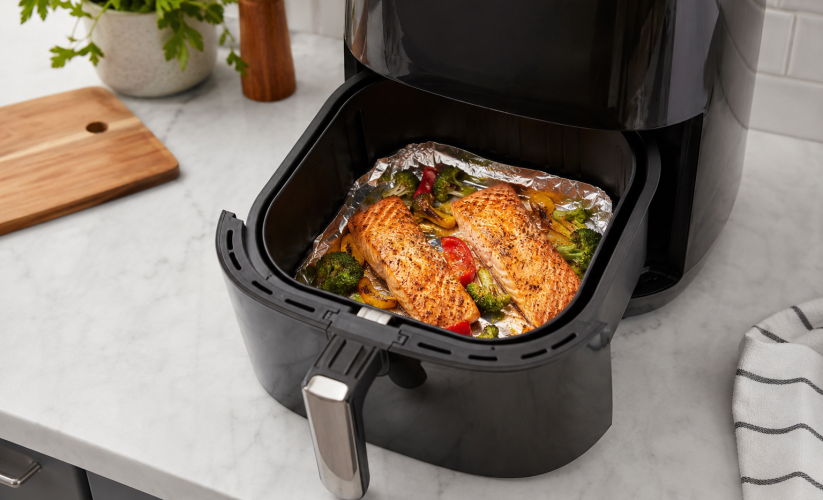
Foil changes the cooking environment. A small piece under a salmon fillet can catch marinade and prevent sticking. A large sheet covering the whole crisper plate can block the air that needs to move under and around the food.
This is why many air fryer problems blamed on the appliance are actually airflow problems. Soggy fries, pale chicken tenders, uneven vegetables, and soft frozen snacks often happen when food is crowded, stacked, or blocked from circulating heat. A solid sheet of foil can create the same issue.
Loose foil creates a different risk. Air fryers move air with enough force to lift lightweight materials. If foil is not weighed down, it can blow upward toward the fan or heating element. That can create smoke, burning, or damage.
Food Network gives similar general air fryer advice: foil can be used when it does not touch the heating element, is weighted down, and is kept away from acidic foods.
The Safe Way to Use Foil in a Ninja Basket Air Fryer
The safest way to use foil in a Ninja basket air fryer is to use a small, flat piece under the food only.
Cut the foil slightly smaller than the food area. It should not climb high up the walls of the basket or cover the entire crisper plate. Keep the edges tucked down so they cannot lift during cooking. Then place the food on top before starting the air fryer.
Do not preheat the Ninja air fryer with loose foil inside. If there is no food holding it down, the foil can move. Add the foil and food together once you are ready to cook.
A good foil setup leaves open space around the edges. That space allows hot air to move around the basket and underneath the crisper plate. If the foil covers every opening, you are no longer air frying efficiently. You are partially steaming or baking on a blocked surface.
A simple rule I follow is this: if the foil is larger than the food, it is probably too large.
The Safe Way to Use Foil in a Ninja Dual-Basket Air Fryer
A Ninja Dual Zone or two-basket air fryer should be treated as two separate air fryers sitting inside one appliance. Each basket needs its own airflow.
Foil can be useful in one or both baskets, especially when cooking sticky proteins, saucy wings, marinated chicken, glazed salmon, or foods that release sugary drips. However, each piece of foil should still be smaller than the basket floor and held down by food.
Do not line both baskets wall-to-wall with foil and expect the same crisping performance. These machines are designed to circulate air inside each basket. When the bottom is covered completely, hot air has less access to the underside of the food.
This matters even more when using Match Cook or Smart Finish features. If one basket has foil and the other does not, the two sides may cook slightly differently. The foil-lined side may brown more slowly, especially with frozen or breaded foods.
Use foil when it solves a specific problem. Skip it when the goal is maximum crispness.
The Safe Way to Use Foil in Ninja Air Fryer Ovens
Ninja air fryer ovens require extra care because the cooking space is more open and the heating elements may be closer to the foil.
In oven-style Ninja models, foil may be allowed on a sheet pan or wire rack, depending on the model. SharkNinja’s support page for the SP150 Series Ninja Flip Toaster Oven and Air Fryer says aluminum foil can be used on the sheet pan or wire rack for easier cleaning after cooking, but the foil must not touch the top heating elements.
That warning is important. A foil sheet that rises, curls, or sits too close to the top of the oven can become a hazard. I would avoid loosely tenting foods in a compact Ninja oven unless there is enough clearance and the foil is firmly shaped.
Do not wrap an entire wire rack in foil. Wire racks are designed to let air move through them. Once the rack is fully covered, it becomes a flat barrier. That can trap grease, slow browning, and increase smoke risk.
If you are using an oven-style Ninja product, the manual should guide the final decision. Some models are more tolerant of foil than others because the tray position, rack clearance, and heating-element layout differ.
When Foil Is Helpful in a Ninja Air Fryer
Foil is most helpful when it solves one of three problems: sticking, dripping, or over-browning.
Sticky marinades are a classic example. Honey, brown sugar, teriyaki sauce, barbecue glaze, and sweet chili sauce can drip and burn onto the basket. A small piece of foil under the food can catch some of that mess.
Foil can also help with delicate foods. Fish fillets, stuffed mushrooms, soft vegetables, and cheese-topped foods can be harder to lift from a crisper plate. Foil gives them a stable surface and makes removal easier.
I also like foil for reheating messy leftovers. A slice of saucy pizza, a cheesy sandwich, or a small portion of roasted vegetables can be easier to manage on foil. Just remember that a fully foil-covered surface can soften the bottom if steam gets trapped.
Foil is also useful as a shield. If the top of a food is browning faster than the inside cooks, a small piece of foil can protect that area. This technique works best in oven-style air fryers, where you have more vertical space.
When You Should Not Use Foil
You should not use foil in a Ninja air fryer when it blocks airflow, sits loose, touches heating elements, or reacts with the food.
Avoid foil during preheating. With no food on top, the foil can shift or lift. Avoid foil with very lightweight foods such as single herbs, thin onion slices, or small pieces of kale unless the food is heavy enough to hold the foil down.
Do not place foil under the basket in an attempt to catch grease unless your specific model instructions say that is allowed. In many basket air fryers, the space below the basket is part of the air circulation path or grease management area. Blocking it can cause overheating, smoke, or poor cooking performance.
Do not use foil as a full basket liner for foods that need crisping. Frozen fries, tater tots, breaded chicken tenders, wings, and frozen snacks usually cook better with maximum airflow.
Most importantly, avoid foil with acidic or highly salty foods. Aluminum can react with acids and salts, especially during heating. That reaction can discolor the foil, affect flavor, and increase aluminum transfer into food.
Acidic Foods and Aluminum Foil
Do not use aluminum foil with acidic or heavily salted foods in a Ninja air fryer.
Common acidic ingredients include tomatoes, lemon juice, lime juice, vinegar, pineapple, pickles, hot sauce, buffalo sauce, and some barbecue sauces. A lemon-marinated fish fillet may sound like the perfect foil-packet meal, but parchment paper is usually a better choice.
This does not mean one accidental contact ruins dinner. It means foil is not the best cooking surface for acidic foods, especially when the food is wet, salty, and heated directly against the foil.
The chemistry is straightforward. Aluminum forms a protective oxide layer, but acids and salts can disrupt that protective surface. Britannica describes aluminum as a lightweight metallic element, and the Royal Society of Chemistry notes that foil is widely used because it is flexible and resistant to many forms of chemical attack. Still, “resistant” does not mean perfect for every acidic cooking condition.
For tomato-based foods, lemony fish, vinegar-heavy marinades, and buffalo cauliflower, I would choose parchment paper or a small silicone liner instead.
Foil vs Parchment Paper vs Silicone Liners
Foil, parchment paper, and silicone liners are not interchangeable. They each solve different problems.
Foil is best when you need structure. Aluminum foil can be folded, shaped, and used to create a small tray. This makes it helpful for sticky glazes, greasy foods, and foods that need a little support. Foil can also reflect heat and protect edges from over-browning.
Parchment paper is better for delicate, breaded, or acidic foods. It is less reactive with acidic ingredients and can reduce sticking without creating the same metallic-contact concern. Perforated parchment is especially useful because the holes preserve more airflow.
Silicone liners are reusable and convenient, but they can reduce crisping if they create a thick barrier between the food and circulating air. They are best for foods where easy cleanup matters more than maximum crunch.
Perforated liners are often the best compromise. They catch some mess while still letting hot air move through the basket.
My preference is simple. Skip liners for fries, wings, and breaded foods. Choose parchment for acidic or delicate foods. Choose foil for sticky, heavy, non-acidic foods that can hold the foil in place.
Does Foil Make Food Less Crispy?
Foil can make food less crispy when it blocks hot air from reaching the bottom and sides of the food.
Air fryers crisp food through air movement. The crisper plate lifts food so hot air can circulate underneath. If foil covers that crisper plate completely, the food loses part of the airflow advantage.
This is why foil works better with salmon than with French fries. A salmon fillet does not need airflow through dozens of small gaps to taste good. Fries do. Breaded snacks do. Chicken wings do.
If crispness matters, use the smallest piece of foil possible. Keep the food in a single layer. Leave exposed space around the food. Flip or shake when appropriate. If the food looks pale underneath, remove the foil for the final few minutes.
Food Network’s air fryer testing guidance also notes that foil and parchment can limit airflow, which may reduce crispiness.
Can You Put Foil Under the Crisper Plate?
I do not recommend putting foil under the crisper plate unless your specific Ninja manual allows it.
The crisper plate is not just a removable insert. It is part of the cooking system. It lifts food so heat can circulate below it. If you put foil underneath the plate, you may block airflow, trap grease, or interfere with how the basket manages heat.
A safer option is to place foil over the crisper plate, directly under the food, while leaving space around the edges. That way, the foil catches some mess without turning the entire lower basket into a blocked surface.
If your goal is cleanup, a short soak after cooking is usually safer than trying to foil-line every hidden surface. Warm water, dish soap, and a nonabrasive sponge can handle most air fryer residue.
Can You Wrap Food in Foil in a Ninja Air Fryer?
You can wrap some foods in foil in a Ninja air fryer, but it changes the cooking method.
A foil packet traps moisture. That can be useful for garlic, fish, small vegetables, or reheating foods you do not want to dry out. It is not ideal for foods that need a crisp surface.
If you wrap food in foil, keep the packet compact and low. Do not let the foil rise toward the heating element. Seal it firmly enough that the edges do not flap in the fan’s airflow. In a basket-style Ninja air fryer, the packet should sit securely in the basket. In an oven-style Ninja model, it should sit on a tray or rack with enough clearance above it.
Foil packets are better for tenderness than crunch. If you want browning, open the packet near the end of cooking or remove the food from the foil for the final minutes.
Common Mistakes to Avoid
The biggest mistake is treating foil like a permanent air fryer liner. A Ninja air fryer is not a regular baking sheet. It needs airflow to work properly.
Another mistake is preheating with foil inside. Without food on top, foil can blow around. This is one of the easiest problems to avoid.
Many people also use too much foil. A small piece under chicken thighs is useful. A full sheet molded tightly across the basket floor is usually not. If the foil covers every vent, hole, or open space, it is working against the appliance.
Using foil with acidic foods is another common issue. Tomatoes, lemon, vinegar, and hot sauce are better paired with parchment or silicone.
Finally, do not ignore smoke. If you see smoke, smell burning, or hear foil moving, stop the appliance, let it cool, and check the basket. Do not reach into a hot air fryer while it is running.
Step-by-Step: How to Use Foil Safely in a Ninja Air Fryer
- Start by checking your model. Look at the Ninja manual or official support page for your exact air fryer. Basket models, dual-basket models, and oven-style models can have different instructions.
- Cut a piece of foil smaller than the basket surface. The foil should sit under the food, not up the walls. Keep it flat and tuck the edges down.
- Add the food immediately. The food should be heavy enough to hold the foil in place. Do not run the appliance with loose foil inside.
- Leave open space around the food and foil. Air should still be able to move through the basket. If the food is crowded, cook in batches.
- Watch the first few minutes, especially if you are trying a new setup. Once you know how your model behaves, you can repeat the method more confidently.
- After cooking, let the basket cool before removing the foil. Hot grease can collect on foil, and folded edges can hold liquid.
Cleaning Tips Without Overusing Foil
Foil is useful, but it should not replace regular cleaning. A Ninja air fryer performs better when grease and crumbs are removed often.
After cooking, let the basket cool. Remove loose crumbs and grease. Wash the basket and crisper plate with warm water, dish soap, and a nonabrasive sponge. Avoid metal scrubbers because they can damage nonstick surfaces.
For stuck-on residue, soak the removable parts before scrubbing. A short soak usually does more than aggressive scraping.
Avoid aerosol cooking sprays unless your model instructions allow them. Some sprays can build up on nonstick coatings. A light coating of oil on the food itself is often enough.
The cleaner the basket stays, the less you will feel the need to line everything with foil.
Best Foods to Cook with Foil in a Ninja Air Fryer
Foil works well with foods that are heavy, sticky, or delicate.
Good options include salmon fillets, chicken thighs, meatballs, glazed wings, garlic bread, stuffed peppers, and saucy leftovers. These foods are heavy enough to hold foil down and often benefit from easier cleanup.
Foil can also help with cheese-topped foods. If melted cheese tends to drip through the crisper plate, a small foil base can catch it.
Use caution with sugary sauces. Foil can catch drips, but sugar can still burn. Lower temperatures and shorter checks can help.
Foods That Are Better Without Foil
Some foods are better cooked directly on the crisper plate or basket surface.
Fries, tater tots, chicken tenders, frozen shrimp, breaded fish, mozzarella sticks, Brussels sprouts, and crispy wings all need strong airflow. Foil can make them softer, especially underneath.
If cleanup is your concern, try parchment with holes or cook in smaller batches. You can also spray or lightly oil the food itself instead of lining the basket.
A good test is to ask what you want from the food. If you want crispness, skip foil. If you want containment, moisture, or easier cleanup, foil may help.
Expert Verdict: Should You Use Foil in a Ninja Air Fryer?
Foil is safe in many Ninja air fryer situations, but it is not always the best choice.
Use foil when it is secured under food, kept away from the heating element, and sized small enough to preserve airflow. Avoid it when cooking acidic foods, lightweight foods, or anything that needs maximum crisping.
The best Ninja air fryer results come from understanding the appliance’s design. Hot air needs space. The fan needs a clear path. The heating element needs distance from loose materials. Once those rules are respected, foil becomes a helpful tool rather than a risk.
FAQs
Can you put foil in a Ninja Foodi air fryer?
Yes, you can put foil in many Ninja Foodi air fryer baskets when it is secured with food and does not block airflow. SharkNinja support states that foil is safe to use in the baskets for some Ninja Foodi 2-Basket Air Fryer models.
Can foil touch the sides of the Ninja air fryer basket?
Foil should not extend high up the sides of the basket. It is better to keep foil flat, low, and tucked under the food. If the foil climbs the sides, it may block airflow or shift during cooking.
Can you use foil in a Ninja Dual Zone air fryer?
Yes, foil can be used in Ninja Dual Zone baskets when each piece is weighed down by food and does not cover the entire basket surface. Treat each basket separately and avoid blocking airflow.
Can you put foil in a Ninja air fryer oven?
Yes, some Ninja air fryer oven models allow foil on the sheet pan or wire rack. SharkNinja says foil should not touch the top heating elements in the SP150 Series Ninja Flip Toaster Oven and Air Fryer. Always check the instructions for your exact model.
Is parchment paper better than foil in a Ninja air fryer?
Parchment paper is better for acidic, delicate, and breaded foods. Foil is better for shaping, catching sticky drips, and supporting heavier foods. Perforated parchment is often the best option when you want easier cleanup without blocking too much airflow.
*We may earn a commission for purchases made using our links. Please see our disclosure to learn more.